The modern digital landscape is a fiercely competitive arena where a website’s success is often measured by its ability to engage visitors and guide them toward a specific action. Many businesses invest substantial time and resources into a website that is visually appealing, with a modern design and brand-aligned aesthetics. However, a beautiful website does not automatically translate into a high-performing one. A website that “looks good” can be secretly failing, characterised by low conversion rates, a high volume of abandoned carts, and a lack of user trust. These metrics represent the silent killers of business growth, undermining marketing efforts and preventing a company from fully capitalising on its digital presence.
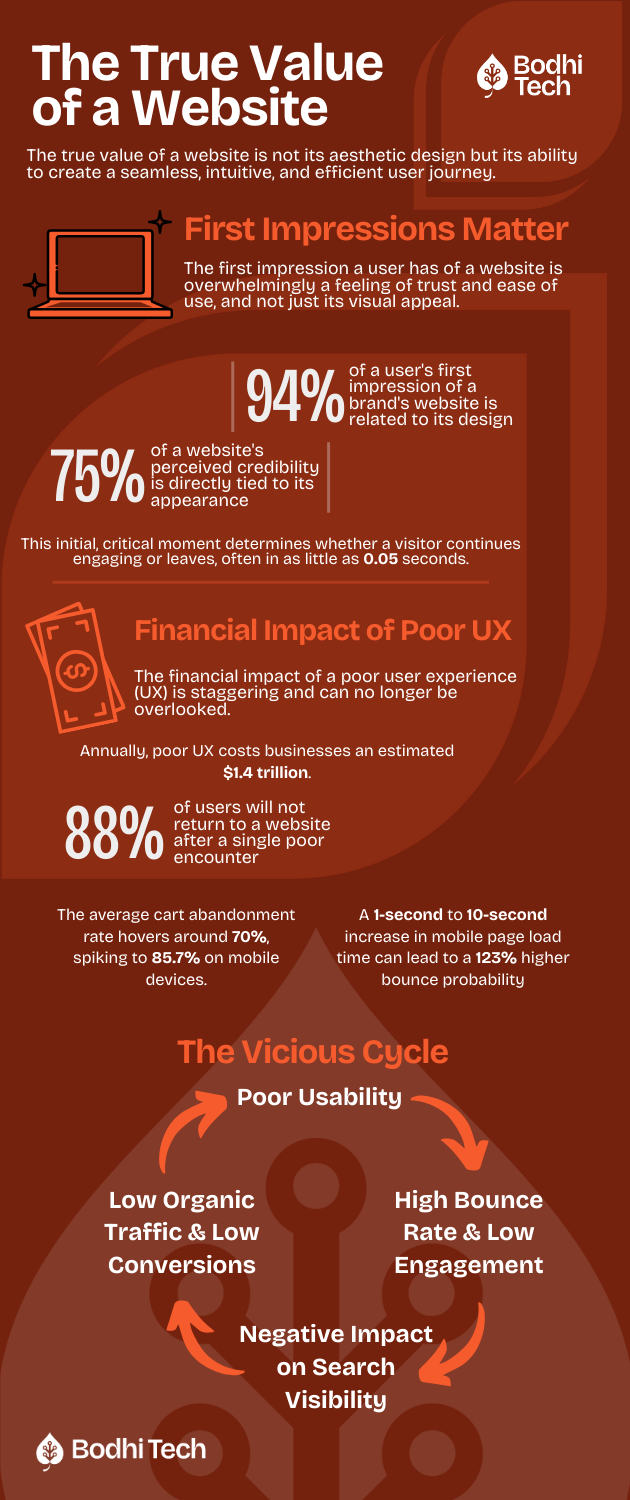
The true value of a website is not its aesthetic design but its ability to create a seamless, intuitive, and efficient user journey. The first impression a user has of a website is overwhelmingly a feeling of trust and ease of use, and not just its visual appeal. A significant 94% of a user’s first impression of a brand’s website is related to its design, and 75% of a website’s perceived credibility is directly tied to its appearance. This initial, critical moment determines whether a visitor continues engaging or leaves, often in as little as 0.05 seconds.
The financial impact of a poor user experience (UX) is staggering and can no longer be overlooked. Annually, poor UX costs businesses an estimated $1.4 trillion. A frustrating online experience leaves a lasting impression, as 88% of users will not return to a website after a single poor encounter. This issue is particularly acute in e-commerce, where the average cart abandonment rate hovers around 70%, spiking to 85.7% on mobile devices. The problem is not limited to e-commerce, as the mobile experience is paramount for all industries. A 1-second to 10-second increase in mobile page load time can lead to a 123% higher bounce probability, a metric that speaks directly to user impatience and the critical need for speed.
The Business Case for UI/UX: The ROI You Can’t Ignore
For business owners and marketing managers, every investment must be justified by a clear return. The case for investing in UI/UX is built on a foundation of compelling, data-backed evidence that demonstrates its direct and significant impact on the bottom line. It’s an investment that transforms a website from a static “cost center” into a dynamic “profit driver.” The evidence shows that a well-designed UI can boost a website’s conversion rate by as much as 200%. When a comprehensive and strategic UX approach is integrated, that figure can climb to 400%. This distinction is critical: UI focuses on the visual interface and its elements, while UX encompasses the entire user journey, from initial discovery to conversion and beyond. An investment in both is an investment in exponential growth.
The financial return on UX investment is staggering. According to research, every $1 invested in UX can yield a return of up to $100. This demonstrates a massive potential ROI of up to 9,900% and establishes a powerful financial incentive for a business to prioritise user experience. Further solidifying this argument, design-driven companies—those that prioritise and systematically invest in design—have been shown to outperform the S&P Index by an impressive 228% over a decade. Similarly, businesses that are recognized as “design unicorns” often see a significant 75% increase in sales. These figures prove that good design is not merely an aesthetic choice but a strategic differentiator that drives market performance and revenue.
Real-world success stories provide tangible proof of this value. One of the most famous examples, detailed in the book “Web Form Design,” involves a simple change to an e-commerce website’s checkout form. The company was losing a significant amount of revenue because a mandatory “Register” button was frustrating customers, leading to a high rate of cart abandonment. The solution was not a redesign of the entire site but a simple, targeted change: replacing the “Register” button with a “Continue” button and adding a message that informed users that an account was not required to complete their purchase. The results were immediate and staggering. Sales grew by 45% in the first month, generating an extra $15 million and ultimately contributing to an overall revenue increase of $300 million. This case study powerfully illustrates how a single, data-informed UX improvement can have a monumental impact.
Another compelling example comes from HubSpot, which faced a problem of declining user retention. A redesign of their record page was unintentionally hampered by excessive usage patterns, which slowed down sales and support workflows and contributed to an 11% decline in user engagement. By conducting live experiments and usability tests, the team was able to identify and eliminate unnecessary white space, reduce load times, and simplify data scanning and actions. The results of this strategic UX intervention were equally impressive, contributing to a 33% increase in the company’s total revenue.
A critical consideration for business leaders is not just the potential return on investment but also the cost of inaction. The research clearly indicates that fixing UX design mistakes during the development phase can cost 10 times more than a fix during the design stage. Once a product or website is launched, the cost of fixing a bug or a user experience problem can escalate to 100 times more than the initial design-phase cost. This reframes the entire decision for a business owner or marketing manager. It is not a question of whether they can afford to invest in UI/UX testing, but rather, whether they can afford to ignore it. Proactive UI/UX testing is therefore not an optional expense but a vital form of risk mitigation and long-term cost savings.
Deconstructing the Digital Experience: The Core Elements of UI/UX
A high-performing website is built on a foundation of fundamental principles that together create a positive and seamless user experience. Understanding these core elements is the first step toward a strategic approach to UI/UX testing.
What Makes a Website “Work”?
Usability and Navigation: At its heart, a website must be intuitive and easy to use. Users should be able to navigate the site and complete their desired tasks—whether making a purchase, filling out a form, or reading an article—without confusion or frustration. Effective navigation involves a clear menu hierarchy, descriptive and straightforward labels for menu items (e.g., “Small Business Tools” instead of a generic “Solutions”), and consistent navigation elements across all pages.
Performance and Speed: In an era of short attention spans, a slow-loading website is a conversion killer. Research shows a direct correlation between page load speed and conversion rates. Pages that load in 2.4 seconds achieve a 1.9% conversion rate, while pages that take 5.7 seconds or longer see their conversion rates plummet to just 0.6%. Even a one-second improvement in load time can increase conversions by up to 2%. Common culprits behind slow speeds include unoptimized images, excessive scripts, and a lack of a Content Delivery Network (CDN).
Mobile Responsiveness and Accessibility: With the majority of web traffic now coming from mobile devices, a website must provide a seamless and optimised experience on any device. The risk of a user abandoning a task on a non-mobile-optimised site is five times higher than on a desktop-optimised one. The user experience should be consistent across all devices, from desktop to smartphone to tablet. Beyond mobile optimisation, accessibility—designing for people with varying abilities—is a moral, legal, and strategic necessity that broadens a business’s potential audience.
Trust and Consistency: A professional and credible website builds user trust from the moment a user arrives. This trust is established through visual consistency, including uniform typography, colour schemes, and layout across the entire site. The use of social proof, such as testimonials, customer reviews, and trust signals (e.g., security badges, client logos), further validates a brand’s credibility and influences purchasing decisions.
Spotting the Red Flags: Common UI/UX Mistakes that Kill Conversions
A website’s performance is often hindered by common, avoidable mistakes that create friction in the user journey. The inverse of the principles of good design, these mistakes serve as red flags that indicate a need for strategic UI/UX intervention. These include:
Confusing Navigation and Site Structure: If users cannot quickly find what they are looking for, they will likely leave. Unclear navigation is a primary reason for high bounce rates and user frustration.
Slow Loading Speed: Pages that take too long to load frustrate users and dramatically increase the probability of abandonment.
Non-Responsive Design: Failing to optimize a website for mobile devices leads to a poor user experience, as content may appear jumbled, navigation becomes difficult, and load speeds can be glacial.
Vague or Ineffective CTAs: A call-to-action (CTA) should be specific, clear, and compelling. Vague phrases like “Click Here” or CTAs that are not visually prominent lead to low click-through rates.
Inconsistent Branding: A lack of consistent design elements—such as varying fonts, colours, or layouts—can confuse users and erode trust in the brand’s professionalism and credibility.
Cluttered Layout and Decision Fatigue: Presenting users with too many options or a cluttered interface can overwhelm them, leading to decision fatigue and ultimately causing them to leave the site without taking any action.
A well-designed UX has a dual impact: it directly improves conversions and also indirectly enhances a website’s search engine optimisation (SEO). A fast, responsive, and easy-to-use site, which are all characteristics of good UX, results in a lower bounce rate and a higher dwell time. Search engines like Google interpret these metrics as signals of a high-quality, valuable website and are more likely to reward it with a higher search ranking. This demonstrates a powerful synergistic relationship where an investment in user experience provides a compound benefit, both improving direct conversion metrics and increasing organic traffic over time.
The most effective approach to improving a website’s UI/UX is not to rely on guesswork or assumptions, but to combine data-driven analysis with direct feedback from real users. The synergy of quantitative data, which tells you what is happening (e.g., a high drop-off rate on a specific page), and qualitative data, which tells you why it is happening (e.g., a user is confused by a form field), is what drives true, impactful change. A strategic toolkit for business owners and marketing managers should include a mix of these methods, many of which can be implemented with minimal cost.
Heatmaps and Session Recordings: These tools provide a visual narrative of how users interact with a page. Heatmaps use color coding to show where users are clicking, how far they are scrolling, and where their attention is focused, with “warmer” colors indicating higher engagement. A heatmap might reveal “rage clicks,” where users repeatedly click on a non-interactive element, which is a clear signal of frustration and a broken interaction. Session recordings, on the other hand, offer a video replay of a user’s entire journey, allowing a team to see exactly what a user experienced, including moments of confusion or hesitation. Tools like Hotjar and Crazy Egg offer these features at an accessible price point, making them valuable for small-to-medium-sized businesses.
A/B and Multivariate Testing: These are methods for scientifically testing hypotheses. After identifying a problem with a heatmap or session recording, a team can form a hypothesis—for example, “Changing the colour of the CTA button will increase clicks because it will stand out more.” A/B testing allows a business to test two different versions of a page, identical except for one variable, to see which one performs better. This moves the optimisation process beyond guesswork, providing data-backed proof that a change had a desired impact on conversion rates. A/B testing is crucial for ensuring that design decisions are driven by evidence, not by opinion.
A strategic, low-cost “Growth Stack” can be a powerful model for a business to follow. The process begins with Heatmaps and Session Recordings to uncover the what and where of user frustration. Based on these findings, the team can form a strategic hypothesis. Next, a quick DIY Usability Test or 5-Second Test with a small group of real people can validate that hypothesis. Finally, a targeted A/B Test can be run to provide the definitive, data-backed proof that the implemented fix improved conversion rates. This systematic, iterative process empowers businesses to continuously optimise their websites with minimal resources, moving from a static website to a dynamic, high-performing growth engine.
Conclusion: From “Just a Website” to “Strategic Asset”
A business’s website is far more than a digital brochure; it is a powerful, dynamic engine for growth, lead generation, and revenue. UI/UX testing is the strategic discipline that ensures this engine is running at its maximum potential. By moving beyond aesthetic judgments and adopting a data-driven approach, a business can systematically identify and eliminate the friction points that are silently costing them revenue and customer loyalty.
The evidence is clear and compelling. The investment in a great user experience yields a massive financial return, with every dollar invested potentially returning up to $100. Real-world case studies demonstrate how simple, targeted improvements can lead to monumental revenue growth, while the costs of neglecting UX can be exponentially higher. A comprehensive approach, combining visual analytics like heatmaps with direct feedback from users through DIY testing, provides a complete picture of the user journey, enabling a business to make confident, data-backed decisions.
Ultimately, the goal is not to have a website that merely exists but one that is a strategic asset, constantly being optimised to convert visitors into loyal customers. The journey begins with a commitment to understanding the user, a commitment that is codified through a systematic UI/UX audit. By taking this first step and embracing an iterative approach to improvement, a business can unlock its full potential in the digital marketplace.